
Why does this knowledge feel unnatural?

Soundtrack for this:
Fame is a gun (triple j Like A Version) - Rebecca black
You can never win a game of tic-tac-toe if you don’t go first.
I learned this lesson way back when I was supposed to prepare for my college entrance exams but I was sitting in classes playing tic-tac-toe by myself. My notebook was littered with X’s and O’s in haphazardly drawn 3x3 grids. The trick was, always start in the middle cell, then the game either ends with you winning or it is a draw, you will never lose. This is one piece of knowledge I still remember from fifteen years ago. No wonder I didn’t get into one of those fancy engineering or medicine schools.
It was fun in the beginning. I wielded this knowledge to taunt and challenge anyone and everyone to a game of tic-tac-toe. Even promising to give them a hundred rupees if they were able to beat me after I make the first move. A slight smugness from finding out something myself and using it to feel taller than others. Needless to say, everyone started finding me too annoying too soon and the sick pleasure in not losing became boring.
The whole idea of a non-winnable game intrigued the hell out of me. This was a clear example of systems that are rigged against us. It doesn’t matter what move you make or how many times you try, If the opponent goes first, you will never win. It kinda captured my teenage angst and sowed seeds of a ‘despair-fueled-nihilism’ in me.
The rules of the game don’t allow you to win no matter what. So now how do we change the rules of the game?
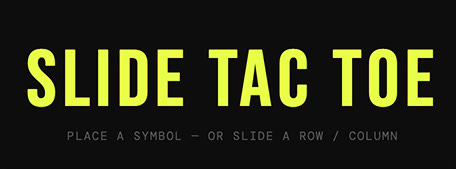
A few years ago, I thought of a game mechanic that could make the game a more level playing field. A sliding mechanism. On a turn, a player can either mark a cell on the 3x3 grid with an X/O or they can move the row or the column one cell up or down. So even if the first move is to mark the central cell in the grid, the other player can easily move it in the next move.
Now paper and pen as the medium becomes the biggest constraint. The movement of already marked X’s or O’s is not possible on paper. So I moved to one of those wooden tic-tac-toe games found in a cafe. It was cumbersome, but there was some meat on the bones of the idea. But I knew, the perfect medium is digital and that made me uncomfortable. Because I didn’t know the strange language of computers but that’s when I decided I wanted to learn coding.
No, there will be no cool montage of me in a black hoodie hunched over a laptop because I couldn’t understand anything. It was properly an alien language where I know the symbols but couldn’t make heads or tails of what the underlying law of this language was. The HTML intro video on youtube said, everything on the internet is made up of rectangular boxes. Instead of learning how to make those boxes, I went down rabbit holes to understand why we are obsessed with rectangles; be it screens, or be it paper. Bottomline, I couldn’t “code” the sliding tic-tac-toe game into a digital reality.
All this was in late 2021 and OpenAI playground was popping up and soon within a year ChatGPT would be launched. I used this new kid on the block to try making the game. Needless to say it was utter crap. A lot of my opinions on ‘AI being overhyped’ formed during those dry winters of 2022.
With every new AI model that released along with the over-the-top promises from those companies’ marketing teams, I used the slide-tac-toe as a test. How well did it understand the mechanism. It was getting marginally better but not as much as the tech news made me want to think. The AI experts of LinkedIn told that it was my ‘prompt’ that was wrong. Spoiler alert, it was not. Just the AI models were crappy. But self doubt didn’t know that, so I thought instead of just getting frustrated using the damn thing, let me try explaining the mechanism to my friends and they understood in just a few sentences.
In the next three years, the world was spinning at 2x speed and these AI companies leeched off enough data to make their stuff better. Two months ago Claude released their new model and I was finally able to talk (prompt?) my way into it to build the game.
I looked at the code Claude wrote generated. The multiple intro classes on youtube that I had taken on HTML, CSS and python made me realise I was looking at code. But couldn’t understand anything. I was supposed to feel super awesome. Bringing something into reality that I just had in my head and some notes in Notion, should have ideally me overjoyed. But something was off. Somehow it felt quite unnatural.
What did I even learn?
The Matrix was launched in 1999 and when I saw that movie nine years later, the first thing that I found totally cool was how Neo and his buddies learned new skills. Neo is lying back on the seat with the wire plugged into the back of his head. The operator inserts a floppy disc, the program loads, Neo closes his eyes and shudders for three seconds and bam! he knows Ju Jitsu.
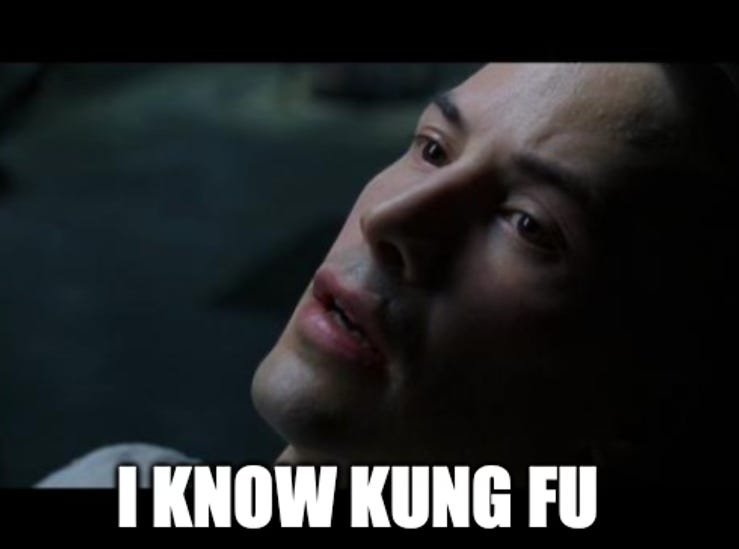
The high school version of me just wanted to go to the dystopian world of matrix. Then I wouldn’t have to memorise stuff for my year end exams. I could just keep playing games all the time. The whole idea of knowledge not just at my fingertips but also the ability to learn it the way I understood, was the shiny eye moment for me. Fifteen years later, AI promised me the very thing.
Why am I finding it unnatural now?
The truth is, there are some inherent voids within us. I believed knowing how to code would fill that somehow.
This void underlined the world that has always told me, coding and talking to computers is the most important language I should know. The same voice that says “I have to be creative, I have to build things, I have to design stuff and I have to satiate the curiosity”. This voice drives me to do whatever I can to fill that void of knowing how to code stuff.
I write prompts for Claude to generate the code for the game. The code is generated, I try it out and makes multiple further prompts to refine and improve it. I see myself enjoying the process. Reading the code for the game gives me a sense of satisfaction I feel like I had been yearning for.
But it is fleeting. Yet there is tiny part at the back of my mind that feels incomplete. It feels unnatural. Whatever code the AI has written, it doesn’t feel mine. The void that I was trying to fill never got filled. I think this is the crucial part of generating anything with AI. The product of the process is never filling that void in me that made me use AI in the first place. The game is made, it is fun to play, it looks great and I still don’t know how to code.
I think that is my struggle with learning stuff using AI. Even at the end when I have made something using stuff I learned with AI, it doesn’t feel mine, it doesn’t feel complete. The knowledge of craft doesn’t feel natural.
I feel something moving, changing forms and taking new shapes within me. It’s just that the void has changed the shape but it continues to exist. Maybe even what I understood to be the void in the beginning, might not be true.
Suggestion Corner
The song mentioned in the beginning.
Wondeful articulation of that feeling of unease. Reminds me of this thing i read somewhere a while back - amateur has its origin in a latin phrase which essentially means ‘to love.’ So everytime one engages in the art of learning something new, acquiring a skill or just diving into the unknown, it is always, at it’s root an act of love. And when all that struggle is surpassed in service of efficiency, all of that love is lost.
I feel it could be because you see it as a creative endeavor. For example if I want to create art, a painting for instance, and I commission someone else (AI) to do it based on my liking, I might not call it "MY" painting. Or I might call it my painting, if I had been a part of corporate credit taking game, you know, like a man with white beard, short white hair and glasses who you see in all posters.
5 grid slide tic tac toe is an awesome game btw. And I think you should take the credit for making it, since it was a non human coder who made codes. :)